
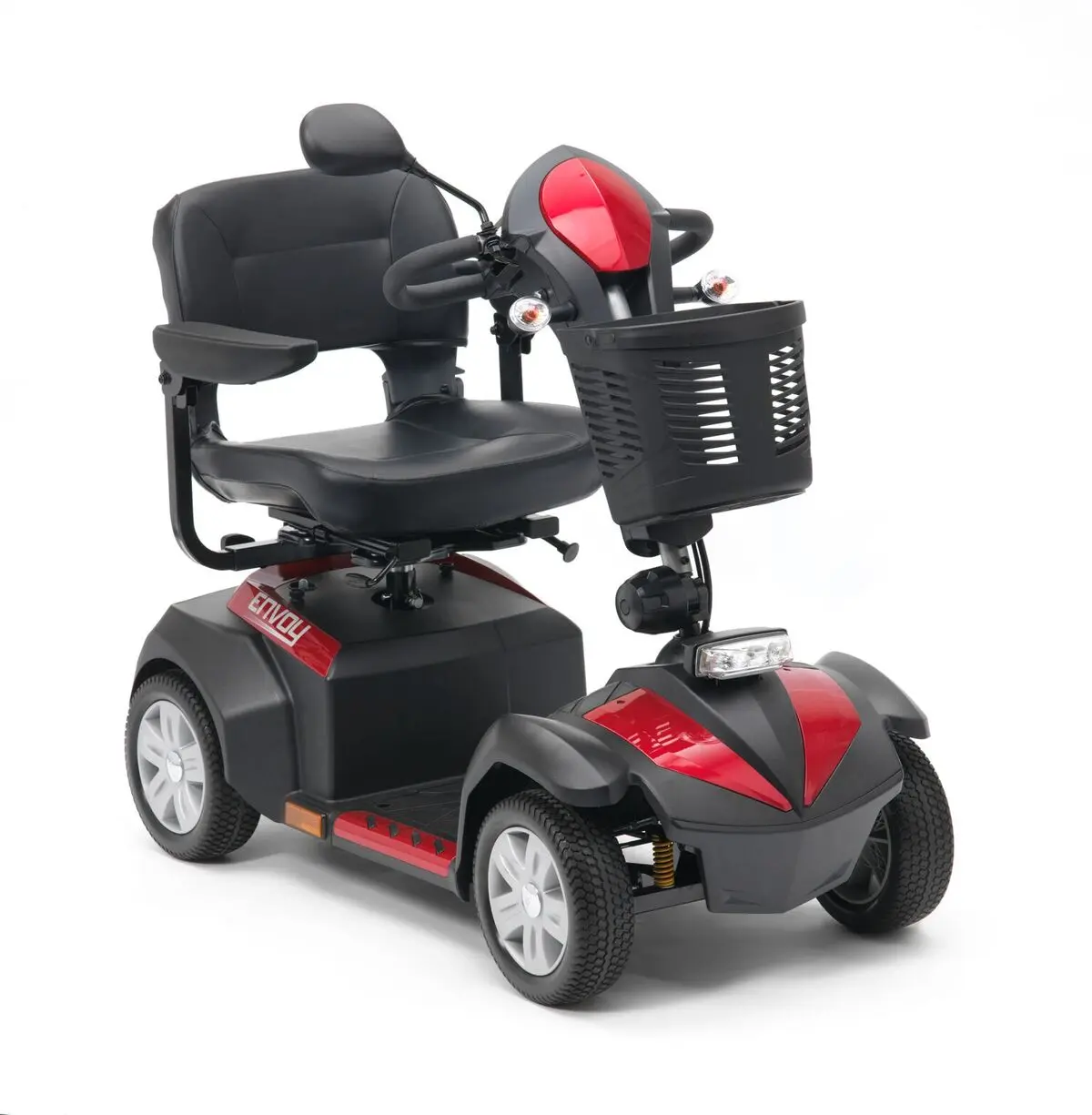
First Choice Mobility Advice Guide
Guide to Buying a Mobility Scooter
Choosing the right mobility scooter isn’t simply about finding one you like the look of. The right scooter should suit you, your journeys, your home, your transport and the way you want to live.
With everything from lightweight folding scooters to larger 8mph road-going models available, knowing where to start can sometimes feel confusing. This guide explains the important differences and the questions worth asking before you buy.
Our aim is simple: to help you make an informed choice and find a scooter that gives you greater independence for the journeys that matter to you.
Freedom, with confidence.
A mobility scooter can be much more than a way of getting from A to B. The right scooter can make shopping easier, help you visit friends and family, enjoy days out and holidays, and give you greater confidence to remain independent.
Start With One Question: How Will You Use Your Scooter?
Before comparing specifications, batteries, colours or prices, think about the journeys you expect your scooter to make.
There is no single mobility scooter that is perfect for everyone. A lightweight scooter that is excellent for taking in the car may not be the best choice for travelling several miles over uneven pavements. Equally, a large road-going scooter may be extremely comfortable but impractical if you need to transport it regularly.
Think about your typical week
- Will you mainly use your scooter for local shops?
- Do you want to travel several miles from home?
- Will you use it mostly on pavements?
- Do you expect to use it on the road?
- Are your local pavements uneven or hilly?
- Will you need to put the scooter into a car?
- Do you want to take it on holidays or flights?
- Will you regularly carry shopping?
- Where will you store and charge it?
- How important are comfort, suspension and longer range?
Understanding the Main Types of Mobility Scooter
Mobility scooters broadly fall into several groups. Understanding these is one of the easiest ways to narrow down your choice.
Small & Transportable Mobility Scooters
Often known as boot scooters, these are designed with portability in mind. Many dismantle into several manageable sections so they can be transported in a suitable car.
Often suitable for:
- Shopping centres
- Days out
- Short local journeys
- Taking in the car
- Occasional rather than long-distance use
Consider: Smaller scooters are convenient, but generally have smaller wheels, less ground clearance and more limited suspension than larger scooters. This can affect comfort on rough or uneven surfaces.
Folding Mobility Scooters
Folding scooters are particularly popular with people who travel regularly. Depending on the model, they may fold manually or automatically and many use lightweight lithium batteries.
Often suitable for:
- Car journeys
- Holidays
- Shopping
- Public transport
- Users with limited storage space
Important: “Folding” does not necessarily mean “lightweight”. Always check the scooter’s total weight, battery weight and whether you or the person helping you can safely lift it.
Medium & Pavement Mobility Scooters
Medium-sized scooters can offer a useful compromise between portability and comfort. They generally have larger wheels, more substantial seating and greater stability than compact boot scooters.
Often suitable for:
- Regular local journeys
- Shopping
- Longer pavement journeys
- Users wanting greater comfort
- Areas with less-than-perfect pavements
Some medium scooters can still be dismantled for transportation, although individual components may be considerably heavier than those of a small boot scooter.
6mph & 8mph Road-Going Mobility Scooters
Larger road-going scooters are designed for people who expect their scooter to be an important form of everyday transport.
They may offer:
- Larger batteries and increased range
- More substantial seating
- Improved suspension
- Larger wheels
- Greater ground clearance
- Lights and indicators
- Mirrors
- Greater stability and comfort
These scooters are generally not designed to be dismantled and lifted into an ordinary car. You will therefore need to consider secure storage, charging and how you intend to transport the scooter if necessary.
Class 2 or Class 3 – What’s the Difference?
In the UK, mobility scooters and powered wheelchairs are legally categorised according to their specification and intended use.
| Feature | Class 2 | Class 3 |
|---|---|---|
| Typical maximum speed | Up to 4mph | Up to 8mph |
| Pavement use | Yes | Yes – maximum 4mph on pavements |
| Road use | No, except where necessary such as crossing a road | Yes, subject to the relevant rules |
| DVLA registration | Generally not required | Required |
| Best suited to | Pavements, shopping and shorter journeys | Longer journeys and road use |
Official guidance: Rules can change, so always check the latest UK Government guidance on mobility scooters and powered wheelchairs:
GOV.UK – Mobility Scooters and Powered Wheelchairs
Should I Choose a 4mph or 6–8mph Scooter?
Bigger and faster isn’t automatically better. The right choice depends on the journeys you actually intend to make.
A 4mph scooter may suit you if…
- You mainly use pavements
- Your journeys are relatively short
- You regularly visit shops or shopping centres
- You want something smaller and easier to manoeuvre
- You need to transport the scooter by car
A larger 6–8mph scooter may suit you if…
- You regularly travel further from home
- You want increased comfort and suspension
- You need greater battery capacity
- You encounter uneven surfaces or hills
- You intend to use a suitable Class 3 scooter on the road
Don’t Choose a Scooter on Speed or Range Alone
Specifications are useful, but they don’t tell the whole story.
A scooter advertised with a long maximum range may still be unsuitable if the seat is uncomfortable, the controls are difficult for you to operate, it is too large for your storage area, or you cannot transport it when needed.
Likewise, quoted maximum range figures are normally achieved under particular test conditions. Hills, cold weather, user weight, tyre pressures, terrain, battery age and repeated stopping and starting can all affect the distance achieved in everyday use.
Mobility Scooter Myth vs Fact
Your 60-Second Scooter Checklist
Before you start comparing individual scooters, answer these questions:
- Where will I use it most?
- How far will I normally travel?
- Do I need to use it on the road?
- Do I need to put it in a car?
- Who will lift it?
- Where will I store it?
- Where will I charge it?
- Are there hills or uneven pavements near me?
- How important is suspension and seat comfort?
- What features are genuinely important to my independence?
Our Advice: Choose for Your Everyday Life
It can be tempting to compare scooters purely by price, range or maximum speed. In practice, some of the most important factors only become obvious when you actually sit on and use the scooter.
Think about the journeys you make now and the journeys you would like to make with greater independence.
In the next part of this guide, we’ll look at comfort, seating, user weight, legroom, controls, suspension and accessibility – all essential considerations when finding a scooter that’s right for you.
Part 2 – Finding the Right Fit
Getting the Right Mobility Scooter for You
Once you have decided which type of mobility scooter is likely to suit your lifestyle, the next consideration is equally important:
does the scooter actually suit you?
Comfort, seating position, legroom, controls, suspension and ease of getting on and off can make a significant difference – particularly if you expect to use your scooter regularly or for longer journeys.
The Scooter Should Fit You – Not the Other Way Around
Two people can try exactly the same scooter and have completely different experiences. Height, weight, leg length, posture, strength, dexterity and mobility can all affect whether a particular model feels comfortable and easy to control.
1. Check the Maximum User Weight
Every mobility scooter has a manufacturer’s stated maximum user weight. This is an important safety specification and should never be ignored.
Remember that the scooter may also be carrying shopping, bags, coats or other items. You should therefore choose a scooter with a suitable capacity rather than routinely operating right at its maximum limit.
Don’t forget what you’re carrying
If you regularly carry shopping or other belongings, consider the overall load being placed on the scooter and follow the manufacturer’s instructions regarding maximum user and carrying capacities.
2. Seat Comfort Matters
A seat that feels perfectly acceptable for five minutes in a showroom may feel very different after an hour of use.
If you expect to make longer journeys, look carefully at the seat design and the support it provides.
Consider:
- Seat width and depth
- Backrest height and support
- Padding and cushioning
- Armrest position and adjustment
- Seat height
- Whether the seat swivels
- Whether the seating position feels natural and supportive
3. Check Your Legroom
Legroom is one of the most commonly overlooked factors when buying a scooter.
Taller users may find some compact scooters restrictive, while shorter users may find that a larger scooter does not provide a comfortable seating position.
Sit naturally with your feet in the normal driving position. Your knees should not feel cramped against the tiller and you should be able to use the controls comfortably without stretching.
Try this before you buy:
Sit on the scooter for more than a few moments. Turn the handlebars fully in both directions and make sure your knees and legs do not obstruct the tiller.
4. Can You Get On and Off Easily?
Getting onto the scooter comfortably and safely is just as important as driving it.
If you have reduced movement in your hips, knees or legs, look at features that may make transfers easier.
Swivel Seat
A swivel seat can allow you to sit down from the side before turning into the driving position.
Flip-Up Armrests
Armrests that move out of the way may make side transfers considerably easier.
Seat Height
A seat that is too low or too high can make standing and sitting more difficult.
5. Make Sure You Can Operate the Controls Comfortably
Most mobility scooters use simple tiller-mounted controls, but the design and amount of pressure required can vary between models.
This can be particularly important if you have reduced strength or movement in your hands or fingers.
Try every control
- Forward and reverse controls
- Speed adjustment
- Horn
- Lights
- Indicators, where fitted
- Ignition/key operation
- Any additional switches or dashboard controls
Don’t assume you will “get used to” awkward controls. If something is difficult to operate during a demonstration, discuss this before buying.
6. Check the Tiller Position
Many scooters allow the steering tiller to be adjusted forwards or backwards. This can help you find a more comfortable driving position.
You should be able to reach and operate the controls without leaning forward excessively or holding your arms in an uncomfortable position.
Remember:
Moving the tiller can also change the available legroom. Adjust the scooter to your normal driving position before deciding whether it feels right.
7. Think About Suspension and Ride Comfort
If your journeys include uneven pavements, dropped kerbs or rougher surfaces, suspension can make a noticeable difference to comfort.
Larger scooters often have more substantial suspension systems and larger wheels, while lightweight transportable scooters may have little or no suspension.
Consider your local area
Think about the actual routes you use. Smooth shopping-centre floors are very different from cracked pavements, uneven paths, slopes and repeated dropped kerbs.
8. Wheels, Tyres and Ground Clearance
Wheel size and ground clearance can affect how comfortably a scooter copes with uneven surfaces.
Compact scooters often use smaller wheels and have lower ground clearance because portability is a priority. Larger scooters generally have bigger wheels and greater clearance.
Solid Tyres
Convenient and puncture-resistant, although ride characteristics vary according to the scooter and tyre design.
Pneumatic Tyres
Air-filled tyres can contribute to a comfortable ride but require correct tyre pressures and can puncture.
9. Don’t Forget the Turning Circle
A large scooter may feel wonderfully comfortable but could be difficult to manoeuvre through narrow entrances, around tight corners or in smaller shops.
Think about where you will actually use and store it.
Check your regular routes
- Garden gates
- Doorways
- Paths alongside your home
- Shop entrances
- Communal corridors
- Lifts
- Storage areas
10. Where Will You Store and Charge It?
This is worth deciding before buying your scooter.
Ideally, a mobility scooter should have a secure and suitable storage location where it can be protected from inappropriate weather exposure and charged in accordance with the manufacturer’s instructions.
Measure the storage area rather than relying on guesswork.
Measure:
- The width of gates and doors
- The scooter’s overall width
- The scooter’s overall length
- Available turning space
- Any steps, thresholds or ramps
- Access to an appropriate charging point
11. If It Is Going in the Car – Check More Than the Boot Size
A scooter fitting physically inside the boot is only part of the question.
You also need to consider how it will get there.
Ask yourself:
- Can I lift the heaviest component safely?
- Can I dismantle and reassemble it?
- Is the boot opening large enough?
- Is there a high loading lip?
- Will I still have room for luggage or shopping?
- Would a vehicle hoist or alternative scooter be more practical?
The Test Drive Matters
Specifications can help narrow down your options, but they cannot tell you exactly how a scooter will feel.
Whenever practical, trying a scooter before buying can help you assess comfort, steering, controls, braking, turning and how easily you can get on and off.
During a demonstration, try:
- Driving forwards slowly
- Reversing
- Turning both ways
- Stopping smoothly
- Getting on and off
- Adjusting the seat and tiller
- Operating every control
- Checking your normal seated position and legroom
Myth vs Fact
Questions Worth Asking Before You Buy
- Is this scooter suitable for my weight and build?
- Can the seat and tiller be adjusted for me?
- Do I have enough legroom?
- Can I comfortably operate every control?
- Can I get on and off safely?
- Does it have suitable suspension for my regular routes?
- Will it fit through my gates and storage area?
- If transportable, what does the heaviest part weigh?
- Can I safely load it into my vehicle?
- Can I try it before making my final decision?
Freedom, with confidence.
The right mobility scooter should feel comfortable, manageable and reassuring to use. It should work around your lifestyle rather than forcing you to adapt your lifestyle around the scooter.
Next, we’ll look at another area that can make a huge difference to everyday ownership: batteries, charging and real-world range – including why the maximum range shown in a brochure may not be the distance you achieve in everyday use.
Part 3 – Batteries, Charging & Range
Understanding Mobility Scooter Batteries and Real-World Range
Battery size and quoted range are important, but they are also two of the most misunderstood parts of buying a mobility scooter.
A scooter’s published maximum range should be treated as a guide rather than a guaranteed everyday distance. Terrain, hills, temperature, user weight, tyre pressure, stopping and starting, battery age and driving style can all affect how far a scooter travels between charges.
Buy for Your Real Journeys – Not the Brochure Maximum
If your regular return journey is close to the scooter’s quoted maximum range, the scooter may not give you enough practical reserve. It is usually better to choose a model that comfortably exceeds the distances you expect to travel.
1. What Does “Maximum Range” Actually Mean?
Manufacturers normally quote an estimated maximum range achieved under specific test conditions. These conditions may be quite different from everyday use.
For example, a test may involve a relatively level surface, correctly inflated tyres, healthy batteries and a particular user weight.
Your actual range can be affected by:
- Hills and gradients
- User weight
- Shopping or other additional loads
- Cold weather
- Battery age and condition
- Low tyre pressures on pneumatic tyres
- Frequent stopping and starting
- Rough or soft surfaces
- Higher-speed driving
- The overall condition and maintenance of the scooter
2. Always Allow a Sensible Range Reserve
It is sensible to avoid planning regular journeys that rely on using nearly all of the scooter’s theoretical battery range.
Leaving a reasonable reserve gives you flexibility if you take a longer route, encounter hills, stop more frequently than expected or experience colder weather.
Example:
If you regularly travel 8 miles in total, choosing a scooter with a comfortably higher stated range will generally be more practical than selecting one whose maximum quoted range is only just above your normal journey.
3. The Main Types of Mobility Scooter Battery
Mobility scooters commonly use sealed lead-acid batteries or lithium batteries. Each has advantages and the right option depends on the scooter and how you intend to use it.
AGM / Sealed Lead-Acid
These are widely used in many mobility scooters and are known for being robust and relatively straightforward to replace.
Advantages can include:
- Widely available
- Proven technology
- Suitable for many everyday scooters
- Often less expensive to replace than lithium
Consider: They are generally heavier than lithium batteries.
Lithium
Lithium batteries are increasingly used in folding and lightweight scooters because they can offer a useful combination of reduced weight and good energy capacity.
Advantages can include:
- Lower weight
- Useful for portable scooters
- Can support compact scooter designs
- Often suited to travel-focused models
Consider: Replacement cost, compatibility and airline transport rules should all be checked carefully.
4. What Does Ah Mean?
Mobility scooter batteries are often described using amp-hours, shown as Ah.
In simple terms, a higher Ah figure usually means a battery has greater energy capacity, but battery size alone does not determine the scooter’s final range.
The scooter’s motor, controller, weight, gearing, tyre type, terrain and driving conditions all influence how efficiently that stored energy is used.
Important:
Do not compare scooters by battery Ah alone. Two scooters with similar battery sizes can still have different practical ranges.
5. Charging Your Mobility Scooter Properly
Good charging habits can help maintain battery performance and reduce the risk of premature battery deterioration.
Always follow the instructions supplied by the scooter and battery manufacturer because charging recommendations can vary between models and battery types.
Good charging habits generally include:
- Using the correct charger supplied or approved for the scooter
- Charging in a suitable, dry and ventilated location
- Following the manufacturer’s recommended charging routine
- Avoiding repeated deep discharge where possible
- Keeping charging plugs and connections in good condition
- Following storage instructions if the scooter will not be used for a prolonged period
6. Use the Correct Charger
Chargers are designed to work with particular battery types and charging systems. A charger that looks similar may not necessarily be suitable.
Using an incorrect or incompatible charger may damage batteries, affect performance or create a safety risk.
Our advice:
If you ever need a replacement charger, identify the exact scooter model and battery system before ordering.
7. Batteries Are Consumable Items
Mobility scooter batteries do not last indefinitely. Over time their capacity gradually reduces and the scooter may travel less distance between charges.
Battery life varies considerably depending on usage, charging routine, storage conditions and battery quality.
Signs batteries may be deteriorating include:
- Noticeably reduced range
- Battery gauge dropping more quickly than usual
- Reduced performance on hills
- Needing to recharge more frequently
- Performance becoming inconsistent
8. Ask About Replacement Battery Costs
When comparing scooters, it is worth considering the future cost and availability of replacement batteries.
A scooter may appear inexpensive initially but could use a battery pack that is costly or difficult to source later.
Before buying, ask:
- What type of battery does the scooter use?
- How many batteries are required?
- How easy are replacements to obtain?
- What is the approximate current replacement cost?
9. Hills Can Make a Big Difference
Travelling uphill requires more energy than travelling on level ground. If you live in a hilly area, this should be part of your buying decision.
A compact scooter that performs perfectly well around a flat shopping centre may not be the most suitable choice for repeated steep local routes.
Think locally:
Consider the steepest hills on the journeys you actually make rather than simply looking at the manufacturer’s maximum gradient specification.
10. Cold Weather Can Reduce Battery Performance
Batteries can perform differently in colder temperatures. This may reduce the practical distance available during winter compared with warmer conditions.
This is another reason why leaving a sensible range reserve is preferable to planning journeys around the scooter’s absolute theoretical maximum.
11. Don’t Treat the Battery Gauge Like a Car Fuel Gauge
Mobility scooter battery indicators provide useful information, but the reading can fluctuate depending on whether the scooter is accelerating, climbing a hill or resting.
With experience you will learn how your particular scooter behaves, but it is still sensible to recharge regularly and avoid deliberately running the battery to complete exhaustion.
12. Travelling by Air? Check the Battery First
If you are buying a scooter specifically for holidays or air travel, battery type and specification are especially important.
Airlines may apply particular requirements to mobility aids and lithium batteries, and individual airline procedures can differ.
Before flying:
- Contact the airline in advance
- Give them the exact scooter model
- Confirm the battery type and rating
- Ask how the battery must be prepared for transport
- Follow the airline’s instructions rather than relying on general claims such as “airline approved”
For further information, see the latest guidance from the
UK Civil Aviation Authority
.
Battery & Range Myth vs Fact
Battery & Range Buying Checklist
- What is the manufacturer’s quoted maximum range?
- How far will I actually travel on a typical day?
- Have I allowed a sensible reserve?
- Are my local journeys hilly?
- What battery type does the scooter use?
- What capacity are the batteries?
- How should they be charged?
- How much do replacements currently cost?
- Are replacement batteries readily available?
- If travelling by air, is the battery suitable for my airline’s requirements?
- Am I buying enough range for future as well as current needs?
Freedom, with confidence.
The most useful range figure isn’t necessarily the largest number in a brochure. What matters is whether the scooter comfortably supports the journeys you want to make without causing unnecessary worry about getting home.
Choose a battery system that suits your lifestyle, follow the correct charging routine and make sure replacement batteries and support will still be available when you need them.
Next, we’ll look at boot scooters, folding scooters and transporting a mobility scooter – including component weights, car boot access, hoists, travelling by train and taking your scooter on holiday.
Part 4 – Folding, Boot Scooters & Transport
Choosing a Mobility Scooter You Can Transport Easily
If you want to take your mobility scooter in the car, on holiday or on public transport, portability can become just as important as comfort and range.
The key is to look beyond whether a scooter is described as “folding” or “transportable”. You also need to consider total weight, the heaviest part, boot access, lifting ability and how easy the scooter is to manage in everyday use.
Portable Does Not Always Mean Lightweight
A scooter may fold into a compact shape and still be difficult to lift. Always check the actual weight you will need to handle and, if possible, try loading the scooter into your vehicle before buying.
1. What Is a Boot Scooter?
A boot scooter is a compact mobility scooter designed to be dismantled into several sections for transport.
Typical sections may include the front chassis, rear motor section, seat, battery pack and basket.
Boot scooters are often popular because they can offer:
- Easy transport in many cars
- Compact storage
- Good manoeuvrability
- Straightforward controls
- Useful mobility for shops, holidays and days out
2. Check the Heaviest Part – Not Just the Total Weight
When comparing dismantling scooters, the total scooter weight is less useful than knowing the weight of the heaviest section you will actually need to lift.
A scooter might weigh 45kg overall but dismantle into manageable pieces. Another may weigh less in total but have one awkward section that is difficult to lift.
Ask the retailer:
“What is the heaviest individual component once the scooter is dismantled?”
3. Manual Folding Mobility Scooters
Manual folding scooters usually remain largely in one piece and fold down to a more compact shape.
This can make them convenient for storage and travel, but because the main frame often remains intact, the total lifting weight can be higher than expected.
A manual folding scooter may suit you if:
- You want quick folding without dismantling multiple sections
- You have limited storage space
- You travel regularly
- You can safely manage the lifting weight
- You prefer a simple folding mechanism
4. Automatic Folding Scooters
Some mobility scooters fold and unfold electrically, often using a remote control or button.
This can make folding easier, particularly for users who find manual mechanisms difficult to operate.
Potential Advantages
- Simple folding process
- Less bending and manual handling
- Compact when stored
- Convenient for frequent travel
Things to Consider
- Overall lifting weight
- Additional electrical mechanisms
- Battery type
- Future servicing and repair support
5. Will It Actually Fit in Your Car?
Never assume that a scooter described as “boot-friendly” will fit every car.
Boot openings, loading heights, wheel arches and interior shapes can vary considerably between vehicles.
Check:
- Boot opening width
- Boot opening height
- Depth of the luggage space
- Loading lip height
- Whether rear seats need to fold down
- Whether you still need space for luggage
- How you will secure the scooter during transport
6. Try the Scooter With Your Own Vehicle
If transporting the scooter regularly is important, one of the best tests is to try loading it into the actual vehicle you intend to use.
This quickly shows whether the scooter is practical for you rather than simply theoretically suitable.
Try this before you buy:
Ask for a demonstration of dismantling, folding, loading and reassembly. If you will normally load the scooter yourself, try each step personally rather than watching someone else do it.
7. Think Carefully About Lifting
Lifting a scooter into a boot can involve reaching forwards, twisting and lifting over a high loading lip.
Even a relatively modest weight can feel much heavier when lifted in an awkward position.
If you are unsure whether you can lift the scooter safely, consider a lighter model, a dismantling scooter with smaller sections or a vehicle loading aid.
8. Vehicle Hoists and Loading Aids
If the scooter you prefer is too heavy to lift manually, a vehicle hoist may provide an alternative.
Hoists vary according to the weight being lifted, the vehicle and how much space is available.
Before considering a hoist, check:
- Scooter lifting weight
- Vehicle compatibility
- Available boot space
- Hoist lifting capacity
- Whether the vehicle suspension is suitable
- Whether professional installation is required
9. Taking a Scooter on Holiday
Mobility scooters can make holidays much more accessible, but travel arrangements should be checked in advance.
Think about how the scooter will be transported at every stage of the journey, not just how it gets into your own car.
Consider:
- Airline battery requirements
- Airport assistance
- Transfers and taxis
- Hotel storage and charging
- Cruise line requirements
- Whether your charger is suitable for the destination
- Availability of repairs or support if something goes wrong
10. Using Public Transport
Policies for mobility scooters can vary between transport providers, vehicle types and routes.
If you expect to use buses, trains, coaches or other public transport regularly, check the operator’s current rules before buying.
Useful information to have:
- Overall scooter length
- Overall width
- Total weight
- Turning circle
- Battery type
11. Understand the Portability Trade-Off
Making a scooter smaller and lighter usually involves compromises somewhere else.
Compact scooters may have smaller wheels, reduced suspension, smaller seats, lower ground clearance or shorter range than larger models.
Prioritise Portability If…
- You travel frequently by car
- You mainly use the scooter at destinations
- Your journeys are relatively short
- Storage space is limited
Prioritise Comfort If…
- You travel longer distances from home
- Your routes include uneven surfaces
- Suspension and seating are important
- You rarely need to transport the scooter by car
Transportable Scooter Myth vs Fact
Transportable Scooter Buying Checklist
- Does the scooter fold or dismantle?
- What is the total weight?
- What is the heaviest individual part?
- Can I safely lift that weight?
- Will it fit through my vehicle’s boot opening?
- Can I load it without excessive bending or twisting?
- Will I still have space for luggage or shopping?
- Would a hoist make more sense?
- Is the battery suitable for the type of travel I plan?
- Have I checked public transport or airline requirements?
- Am I comfortable with the trade-off between portability and ride comfort?
Freedom, with confidence.
A transportable scooter should make life easier, not create a new challenge every time you want to go out.
The right model should be practical to fold or dismantle, manageable to load, suitable for your car and comfortable enough for the journeys you want to make.
Next, we’ll look at Class 3 road-going scooters, DVLA registration, road use, lights, indicators, mirrors, insurance, breakdown cover and staying safe.
Part 5 – Road-Going Scooters & Staying Safe
Choosing and Using a Class 3 Road-Going Mobility Scooter
If your mobility scooter is going to become an important form of everyday transport, a larger Class 3 road-going scooter can provide greater range, comfort and independence.
However, using a mobility scooter on the road brings additional responsibilities. Before buying, it is important to understand the difference between Class 2 and Class 3 vehicles, DVLA registration, speed limits, required equipment and the rules that apply when travelling alongside other road users.
A Road-Going Scooter Is More Than Just a Faster Scooter
A Class 3 mobility scooter intended for road use must meet particular legal requirements. It should therefore be selected with the same care you would give to any other important means of transport.
1. What Is a Class 3 Mobility Scooter?
Class 3 mobility scooters and powered wheelchairs are designed so they can be used on the road as well as on pavements and other permitted areas.
They typically have a maximum speed of up to 8mph and must be restricted to a maximum of 4mph when used on pavements and pedestrian areas.
Class 3 scooters commonly offer:
- Greater battery capacity
- Longer potential range
- Larger wheels
- Improved suspension
- More substantial seating
- Lights
- Indicators
- Horn
- Rear-view mirror
2. Does a Class 3 Mobility Scooter Need to Be Registered With DVLA?
Yes. Class 3 mobility scooters and powered wheelchairs must be registered with the Driver and Vehicle Licensing Agency (DVLA).
There is no vehicle tax to pay when the vehicle is correctly registered with DVLA as a mobility scooter or powered wheelchair, but the registration requirement still applies.
Buying a Class 3 scooter?
Ask the retailer whether the scooter has already been registered and, if appropriate, what information or documentation you need to provide to DVLA.
You can find current guidance at
GOV.UK – Vehicle Tax, Registration and Insurance
3. What Equipment Does a Road-Going Scooter Need?
A mobility scooter used on the road must meet the relevant legal requirements for road use.
Road-going equipment includes:
- An efficient braking system
- Front and rear lights
- Front and rear reflectors
- Direction indicators
- Indicators capable of operating as hazard warning lights
- A rear-view mirror
- An audible horn
- A clear view of the road and traffic ahead
Always check the current requirements before using your scooter on the road:
GOV.UK – Driving a Mobility Scooter on the Road
4. Remember the 4mph Pavement Limit
Even if your Class 3 scooter is capable of travelling at 6mph or 8mph, you must not exceed 4mph on pavements or in pedestrian areas.
In busy areas it may be necessary to travel considerably slower than 4mph.
A useful rule of thumb:
Around pedestrians, match your speed to the conditions rather than treating 4mph as a target. Give people plenty of space and remember that children, older people, people with hearing or visual impairments and other pedestrians may not realise you are approaching.
5. Using Your Scooter on the Road
A suitable Class 3 mobility scooter can be used on most roads, but travelling amongst cars, vans, buses and bicycles requires concentration and good judgement.
Because a mobility scooter travels substantially slower than most motor traffic, visibility and positioning are particularly important.
When using the road:
- Use your mirrors regularly
- Signal clearly and in good time
- Make sure lights and indicators are working
- Avoid sudden changes of direction
- Be especially careful at junctions
- Watch carefully for vehicles entering and leaving driveways
- Take extra care around parked vehicles
- Follow the Highway Code
6. Dual Carriageways Require Particular Care
Mobility scooters should avoid fast dual carriageways wherever a safer alternative route is available.
If a Class 3 vehicle is used on a dual carriageway where the speed limit exceeds 50mph, current rules require the use of a flashing amber beacon.
Our advice:
Wherever possible, plan a quieter alternative route rather than using a high-speed dual carriageway.
7. Mobility Scooters Must Not Be Used on Motorways
Mobility scooters and powered wheelchairs must not be used on motorways.
When planning longer journeys, make sure your route is suitable for your scooter before setting out.
8. Read the Highway Code
Anyone using a mobility scooter should understand the Highway Code rules that apply to powered wheelchairs and mobility scooters.
These cover pavement use, road use, speed, visibility, pedestrian safety, junctions and other important situations.
Read the latest official guidance:
The Highway Code – Rules 36 to 46
.
9. Make Yourself Easy to See
Visibility matters at any time of day, but it becomes particularly important in poor weather, at dusk and after dark.
Before every journey, make sure lights, reflectors and indicators are clean and working correctly.
Think visibility:
- Use lights when visibility is poor
- Keep reflectors clean
- Check indicators before setting off
- Avoid clothing or luggage obscuring lights
- Consider high-visibility clothing or accessories where appropriate
10. Your Eyesight Must Be Good Enough to Use the Scooter Safely
GOV.UK guidance states that users of Class 2 and Class 3 mobility scooters should be able to read a car registration number from a distance of 12.3 metres (40 feet).
Good vision is particularly important when judging distances, identifying hazards and travelling around pedestrians or road traffic.
11. Do I Need Mobility Scooter Insurance?
Insurance requirements can depend on the vehicle, including its weight, so you should check the current rules for your particular scooter.
Even where insurance is not legally required, suitable mobility scooter insurance is well worth considering.
Depending on the policy, cover may include:
- Third-party liability
- Accidental damage
- Theft
- Vandalism
- Other benefits depending on the insurer and policy selected
Always read the policy terms, exclusions and limits carefully.
12. Consider Breakdown Recovery
If your scooter is your main way of getting around, a breakdown several miles from home can create a significant problem.
Breakdown recovery can therefore be particularly valuable for people who regularly make longer journeys.
Before buying cover, check:
- Where recovery is available
- Whether the rider is taken home
- Whether the scooter is also transported
- Any distance limits
- Any exclusions or call-out limits
13. Your Pre-Journey Safety Check
A quick check before setting off can help identify simple problems before they become more serious.
Before a journey, check:
- Battery charge level
- Tyre condition and pressure where applicable
- Lights
- Indicators
- Horn
- Mirrors
- Brakes
- Seat correctly locked into position
- Basket and luggage secure
- You have sufficient battery range for the planned journey
14. Adjust Your Driving for the Conditions
Rain, wet leaves, ice, strong winds, poor visibility and uneven surfaces can all affect safe scooter use.
Slopes and kerbs should always be approached carefully and within the manufacturer’s operating guidance.
If conditions are poor, slowing down or postponing a non-essential journey may be the safer option.
15. Take Care With Kerbs, Slopes and Cambers
Every scooter has limits regarding gradients, kerb heights and the surfaces it is designed to negotiate.
Never assume that because a large scooter looks powerful it can safely climb any kerb or slope.
Important:
Follow the manufacturer’s instructions regarding maximum gradients, kerbs and safe operation. Wherever possible, use proper dropped kerbs rather than attempting to climb ordinary kerbs.
Road-Going Scooter Myth vs Fact
Class 3 Scooter Buying Checklist
- Is the scooter genuinely suitable for my normal journeys?
- Does it have enough real-world battery range?
- Is the seat comfortable for longer journeys?
- Does it have suitable suspension?
- Can I operate all controls comfortably?
- Does it meet the requirements for road use?
- Has the DVLA registration been dealt with?
- Do I understand the 4mph pavement limit?
- Have I considered insurance?
- Would breakdown recovery be worthwhile?
- Are servicing and spare parts readily available?
- Do I understand the Highway Code rules that apply to me?
Freedom, with confidence.
A road-going mobility scooter can open up considerably more independence, particularly if you no longer drive or find longer walking distances difficult.
The key is to choose a scooter that suits your journeys, understand the rules that apply and keep the vehicle properly maintained.
Next, we’ll look at buying new, used or reconditioned mobility scooters – including warranties, batteries, servicing history, spare-parts availability and the important checks to make before buying second-hand.
Part 6 – New, Used & Reconditioned Scooters
Should You Buy New, Used or Reconditioned?
A mobility scooter does not always have to be brand new to be a good purchase, but second-hand buying requires more care.
The important question is not simply how old the scooter is. You should also consider battery condition, servicing history, wear and tear, spare-parts availability, warranty support and who has inspected the scooter before sale.
The Cheapest Scooter Is Not Always the Cheapest to Own
A low purchase price can quickly become poor value if the scooter needs new batteries, tyres, a charger, major repairs or parts that are difficult to obtain.
1. Buying a New Mobility Scooter
Buying new generally gives you the widest choice of models, specifications, colours and seating options.
It also usually gives you the clearest warranty position and the reassurance that the scooter has not had a previous working life.
Advantages of buying new can include:
- Manufacturer warranty
- Latest model specifications
- New batteries
- No previous wear and tear
- Greater choice of colours and options
- Clearer after-sales support
2. What Does “Reconditioned” Mean?
The term “reconditioned” can mean different things depending on the seller.
A properly reconditioned scooter should have been inspected, tested and prepared for resale rather than simply cleaned and placed back on sale.
A thorough reconditioning process may include:
- Full functional inspection
- Battery testing
- Brake checks
- Tyre inspection
- Steering and tiller checks
- Lights and indicators tested where fitted
- Seat and armrests checked
- Charger tested
- Any necessary repairs completed
- Cleaning and preparation before resale
3. Buying Privately
Private sales can sometimes appear attractive because of the lower asking price, but they usually involve more risk.
You may have little or no warranty, limited information about the scooter’s previous use and no certainty that the batteries or major components are in good condition.
Be particularly cautious if:
- The seller cannot explain the scooter’s history
- The batteries are old
- The charger is missing or incorrect
- The scooter has warning lights or fault codes
- There is visible damage to the frame or bodywork
- Spare parts are no longer readily available
4. Battery Condition Can Change the True Cost
Batteries are one of the most important things to check on any used scooter.
A scooter that appears cheap may need replacement batteries almost immediately, adding significantly to the real purchase price.
Ask:
- How old are the batteries?
- Have they been tested?
- How long does the scooter currently run between charges?
- Are they the correct batteries for the scooter?
- How much would replacements cost?
5. Inspect Tyres, Brakes and Steering
Wear in tyres, steering and braking components can affect comfort, safety and future repair costs.
A proper inspection should look for uneven tyre wear, cracking, play in the steering, abnormal noises and any sign that the scooter does not stop smoothly.
6. Cosmetic Damage Can Tell You Something
Scratches and scuffs are common on older scooters and are not automatically a reason to reject one.
However, more serious cracks, badly damaged panels or signs of repeated impact may indicate the scooter has had a harder life.
Look beyond appearance:
A shiny scooter with tired batteries may be a worse purchase than one with a few cosmetic marks that has been mechanically well maintained.
7. Make Sure the Correct Charger Is Included
Used scooters are sometimes sold with missing, damaged or incorrect chargers.
The charger must be compatible with the scooter’s battery system. Replacing a missing charger also adds to the true cost of the purchase.
8. Are Spare Parts Still Available?
This is especially important when considering older or discontinued models.
A scooter can be mechanically sound today but become difficult to maintain if controllers, motors, body panels, tyres or other components are no longer available.
Before buying, ask:
- Is the manufacturer still trading?
- Is the model still supported?
- Are mechanical parts available?
- Are electronic parts available?
- Can a local mobility retailer service the scooter?
9. Ask About Servicing History
A documented service history can provide useful reassurance, particularly on larger road-going scooters.
Even where complete records are not available, ask what work has been carried out and whether the scooter has been inspected before sale.
10. Always Test Drive a Used Scooter
A test drive is particularly important when buying used.
During the test drive, check:
- Smooth acceleration
- Smooth braking
- Steering feels secure
- No unusual noises
- No warning lights or fault codes
- Comfortable seating
- All switches and controls work
- Lights and indicators operate where fitted
- The battery gauge behaves normally
11. What Warranty Is Included?
Warranty arrangements can differ considerably between new and reconditioned scooters.
Before buying, understand exactly what is covered, for how long and what happens if a fault develops.
Ask specifically:
- How long is the warranty?
- Are batteries included?
- Are labour costs included?
- Is the warranty return-to-base?
- What items are excluded as normal wear and tear?
12. Mileage Is Only Part of the Story
Some scooters display mileage or hours of use, but these figures should not be considered in isolation.
A low-mileage scooter that has been stored with neglected batteries may need more immediate attention than a higher-mileage scooter that has been regularly serviced and properly maintained.
13. Be Careful With Very Old Models
Older scooters can still provide excellent service, but age increases the importance of parts availability and technical support.
Before buying an older model, make sure it can still be economically maintained.
14. Questions to Ask a Private Seller
- How old is the scooter?
- Why is it being sold?
- How old are the batteries?
- When was it last serviced?
- Has it ever had a major repair?
- Is the correct charger included?
- Are all keys included?
- Do all lights, indicators and controls work?
- Are manuals or service records available?
- Can I test drive it before buying?
New & Used Scooter Myth vs Fact
Used & Reconditioned Scooter Buying Checklist
- Has the scooter been professionally inspected?
- How old are the batteries?
- Have the batteries been tested?
- Are tyres and brakes in good condition?
- Does the steering feel secure?
- Does every control work correctly?
- Is the correct charger included?
- Are spare parts still readily available?
- Is there a service history?
- What warranty is included?
- Can I test drive it?
- Have I compared the true cost with a new scooter?
Look at Value, Not Just Price
A well-prepared reconditioned mobility scooter can be a sensible way to access a higher-specification model at a lower price than buying new.
The important difference is knowing what you are actually buying.
Inspection, battery testing, servicing, warranty support and access to spare parts can all be worth considerably more than simply choosing the lowest advertised price.
Freedom, with confidence.
Whether you choose new or reconditioned, the aim should be exactly the same: a mobility scooter that is safe, reliable, comfortable and properly supported.
A carefully selected reconditioned scooter can represent excellent value, while buying new may offer greater choice and longer-term reassurance.
In the final part of this guide, we’ll bring everything together with a complete mobility scooter buying checklist, common mistakes to avoid, frequently asked questions and useful links to help you make your final decision with confidence.
Part 7 – Final Buying Checklist
Bringing Everything Together
By this stage you should have a much clearer idea of the type of mobility scooter that suits your lifestyle, your journeys and your individual needs.
The final step is to bring all of those considerations together before making your decision. The checklist below is designed to help you compare scooters properly rather than choosing on price, appearance or headline specifications alone.
The Best Scooter Is the One That Fits Your Life
A mobility scooter should increase your independence, confidence and enjoyment of everyday life. The right choice is not necessarily the fastest, lightest, largest or most expensive scooter – it is the one that works best for you.
Your 15-Point Mobility Scooter Buying Checklist
Before placing an order, work through these questions one by one.
- Where will I use the scooter most?
Pavements, shopping centres, longer local journeys, the road, holidays or a mixture of these? - How far will I normally travel?
Choose enough practical battery range for your regular journeys with a sensible reserve. - Is it comfortable?
Check the seat, backrest, armrests, suspension and overall driving position. - Do I have enough legroom?
Make sure you can sit naturally and turn the tiller without your knees getting in the way. - Can I operate all the controls easily?
Test forward, reverse, speed control, horn, lights and indicators where fitted. - Can I get on and off safely?
Consider seat height, swivel seat and flip-up armrests. - Is the scooter suitable for my weight?
Check the manufacturer’s maximum user weight and allow for shopping or other items you regularly carry. - Will it cope with my local terrain?
Think about hills, uneven pavements, dropped kerbs and ground clearance. - Where will I store and charge it?
Measure gates, doorways and storage areas and make sure you have a suitable charging location. - Do I need to transport it by car?
Check boot size, lifting weight and the heaviest individual component. - What type of battery does it use?
Consider battery weight, charging requirements, replacement cost and availability. - Are servicing and spare parts available?
Good long-term support can be just as important as the initial purchase price. - What warranty is included?
Understand the duration, exclusions and whether the warranty is return-to-base. - If it is Class 3, has registration been considered?
Understand DVLA registration and the rules for road and pavement use. - Have I actually tried the scooter?
Whenever practical, test driving is one of the best ways to find out whether a scooter genuinely suits you.
Common Mobility Scooter Buying Mistakes
Many unsuitable purchases happen because one specification is given too much importance while practical everyday needs are overlooked.
Choosing on Price Alone
A cheap scooter that is uncomfortable, unsuitable or expensive to repair can quickly become poor value.
Buying Too Large
Bigger scooters can offer excellent comfort but may be difficult to store, manoeuvre or transport.
Buying Too Small
A compact scooter may be wonderfully portable but unsuitable for long distances or rough local pavements.
Relying on Quoted Range
Brochure range figures are useful for comparison but should not be treated as guaranteed everyday distances.
Ignoring Lifting Weight
A scooter fitting in the boot is of little use if you cannot safely lift it into the car.
Ignoring Future Support
Batteries, chargers, tyres and spare parts will eventually be needed. Make sure the scooter can be supported long term.
Before You Order – Ask These Questions
- Is this scooter appropriate for the journeys I have described?
- What is the heaviest part?
- What real-world range should I reasonably expect?
- What batteries does it use?
- How much do replacement batteries currently cost?
- Are spare parts readily available?
- What warranty is included?
- What servicing is recommended?
- Can I try it before buying?
- What happens if I need help after the purchase?
Frequently Asked Questions
Do I need a driving licence to use a mobility scooter?
No driving licence is required to use a mobility scooter, but users should be able to operate the vehicle safely and understand the rules that apply.
Do I need to register my mobility scooter?
Class 3 mobility scooters must be registered with DVLA. Class 2 vehicles generally do not require registration. Always check current GOV.UK guidance for your particular vehicle.
Can I use an 8mph scooter on the pavement?
Yes, a suitable Class 3 scooter can be used on the pavement, but its speed must be limited to no more than 4mph. In busy pedestrian areas you should travel more slowly where necessary.
How far can a mobility scooter travel?
This varies considerably between models. Always treat the manufacturer’s quoted range as a guide because hills, temperature, user weight, battery condition and terrain can all affect actual distance.
How long do mobility scooter batteries last?
There is no fixed lifespan. Battery life depends on battery type, frequency of use, charging habits, storage conditions and general care. Rechargeable batteries gradually lose capacity and will eventually require replacement.
Can I take a mobility scooter on an aeroplane?
Often yes, but you must check with your airline before travelling. The airline will usually need details of the exact scooter and battery, particularly where lithium batteries are involved.
Should I buy a folding scooter or a boot scooter?
This depends on how you intend to transport it. Folding scooters can be quick to prepare, while dismantling boot scooters may divide into lighter individual components. Check the actual lifting weights before deciding.
Is a reconditioned mobility scooter worth considering?
Yes. A properly inspected and prepared reconditioned scooter can offer excellent value, particularly if it includes warranty support and replacement parts remain readily available.
Do mobility scooters need insurance?
Insurance requirements can depend on the scooter, so check the current rules. Even where it is not compulsory, appropriate insurance can provide useful protection against third-party claims, theft or accidental damage depending on the policy.
What is the most important thing to consider when buying a mobility scooter?
Suitability. The scooter should fit your physical needs, journeys, home, transport arrangements and lifestyle rather than being chosen because one particular specification looks impressive.
Final Myth vs Fact
Useful Mobility Scooter Information
For current official guidance, the following resources may be helpful:
You May Also Find These Guides Helpful
Buying the right scooter is only part of confident mobility. You may also want to read our other practical guides covering:
Practical guidance for mobility scooter users on pavements and roads.
Understand when eligible customers may purchase qualifying mobility products without VAT.
Help maximise performance and care for your mobility scooter batteries.
Travelling With a Mobility Scooter
Useful advice for cars, holidays and airline travel.
Need Help Choosing?
If you’re still unsure which type of mobility scooter would best suit your needs, talk to us.
At First Choice Mobility, we can help you compare the practical differences between models, including comfort, weight, range, batteries, transportability and suitability for the journeys you want to make.
Our aim isn’t simply to help you buy a mobility scooter – it’s to help you choose the right mobility scooter.
Freedom, with confidence.
The right mobility scooter can help you remain active, independent and connected to the people and places that matter to you.
Take your time, ask questions, try different options where possible and choose a scooter that gives you confidence every time you set off.